What is happening?
A new international study has shown how coral reefs will change as ocean acidity rises. Scientists from the Australian Institute of Marine Science in Townsville and partners studied rare volcanic CO2 seeps in Papua New Guinea to see how reefs respond to long-term exposure to high carbon dioxide.
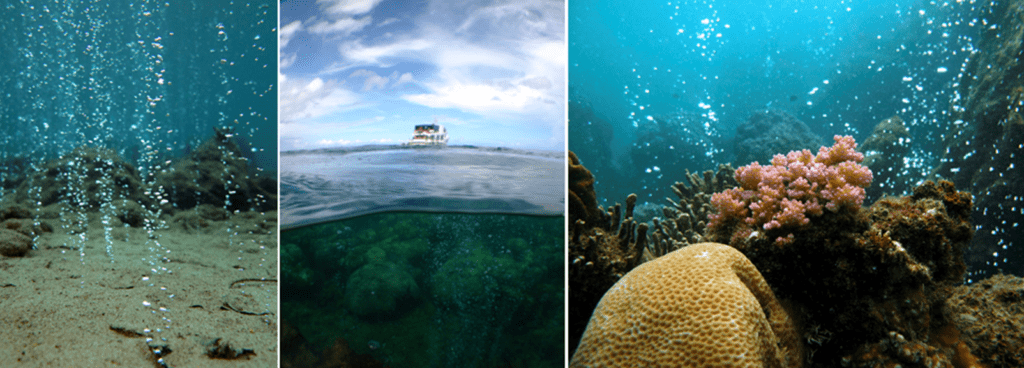
The study, published in Communications Biology, examined entire reef systems exposed to CO2 drifting up from shallow submarine volcanoes. The CO2 is almost pure and creates natural acidity gradients across the reefs.
Dr Katharina Fabricius from AIMS in Townsville said the sites provide an unmatched look into the future. “These unique natural laboratories are like a time machine,” said Dr Fabricius.
“The CO2 seeps have allowed us to study the reefs tolerance limits and make predictions. How will coral reefs cope if emissions are in line with the Paris Agreement level emissions? How will they respond to higher CO2 emissions scenarios?”
Researchers assessed 37 reef sites along a 500 metre gradient of CO2 exposure.
Dr Sam Noonan from AIMS in Townsville said the trend was clear. “These Papua New Guinea reefs are telling us that with every bit of increase in CO2, we will see fewer corals and more fleshy algae. Importantly, we also found far fewer baby corals, which means reefs will not be able to grow and recover quickly. That has implications for all the species that depend on them, including humans.”
Why it matters?
By 2100, coral reefs in Australia and worldwide will be slower to recover and dominated by fleshy algae. The shift will reduce complex coral structures, which support fish and protect coastlines.
Oceans absorb carbon dioxide from the air. This changes seawater chemistry and makes coral limestone dissolve more easily. Reef health declines step by step as acidity rises.
Local Impact
Many coastal regions rely on fish that depend on coral for early life stages. Fewer baby corals and slower recovery put these links at risk. Reef change affects culture, food, tourism and ecosystem stability.
By the Numbers
-
Ocean acidity has already increased by 30 percent, and pH may fall to 7.8 by 2100.
-
Habitat forming corals and coralline algae dropped by over 50 percent as aragonite saturation fell from present levels to 2.
-
The team surveyed 37 sites along a 500 metre CO2 gradient to track ecosystem change.
Zoom In
Dr Fabricius first saw gas escaping from coral reefs while surveying species in Milne Bay in 2000, about 500 km east of Port Moresby.
When ocean acidification became a major issue, she recalled the site and tested the gas in 2009. It was almost pure CO2. This discovery started a decade of field research led from Townsville through AIMS.
Reaching the reefs was not simple. The team flew to Papua New Guinea, then to Milne Bay Province, then travelled six hours by boat. “The coral reefs in Milne Bay are amazing, and the local people so welcoming. It was a real privilege to work at their reefs with these volcanic CO2 seeps, which are globally unique,” Dr Fabricius said.
She said the reefs showed slow but steady change across the CO2 gradient. “There was no sudden collapse or tipping point, instead, as the CO2 increased, we saw fleshy algae became dominant, replacing and smothering coral and calciferous algae.”
Zoom Out
The findings link with shifts already starting on the Great Barrier Reef, which is also studied from Townsville through AIMS.
“We have observed coral reefs starting to change in response to CO2 gradients in the Great Barrier Reef. The Papua New Guinea reefs tell us what will happen next,” Dr Fabricius said.
She said the global picture remains underreported. “Ocean acidification is a massive global problem, which has been understudied and underreported to date. This research is a first of its kind, presenting unique field data and allowing us to assess how whole communities change in the real world. The more CO2 we emit into the atmosphere, the greater the changes will be to coral reefs and the coastal communities which depend on them.”
The study involved AIMS in Townsville, the University of Western Australia and partners in Saudi Arabia.
What to Look For Next
The study provides emission pathway comparisons that will guide future reef forecasts. Models such as SSP2 4.5 and SSP3 7.0 will remain key in tracking how reef decline matches global CO2 levels.